
Addressable Fire Alarm Systems India Guide: Choosing the Right Fire Safety Solution
October 28, 2026
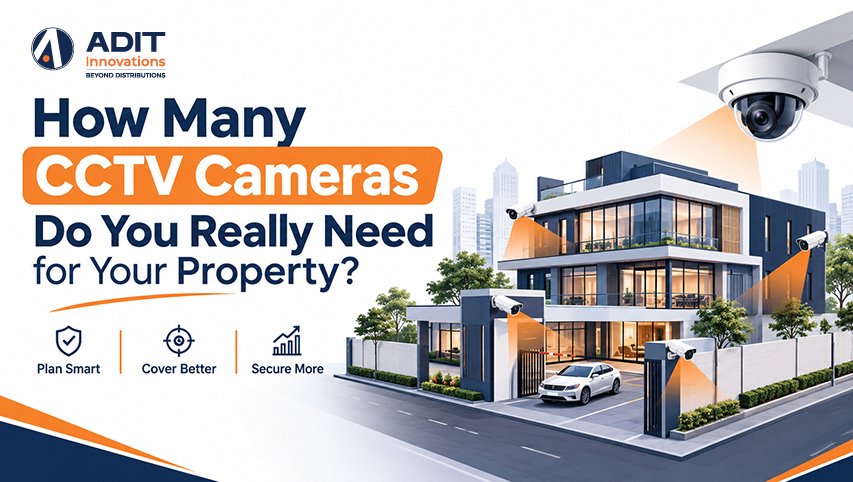
How Many CCTV Cameras Do You Really Need for Your Property?
November 20, 2026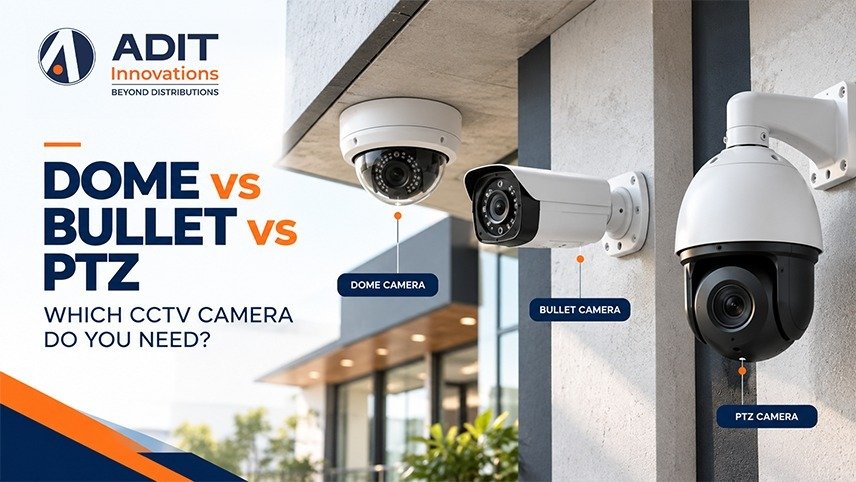
Why Camera Form Factor Matters in a CCTV Camera System
Form factor describes the physical design of a CCTV camera, and it decides where the camera can be mounted, how wide an area it covers, and how much detail it records. Dome, bullet, and PTZ cameras are the three most common choices in a CCTV camera system. Each one is built for a particular kind of placement, so understanding the differences helps match the camera to the task.
The three types are not rivals in the strict sense. A fixed camera such as a dome or bullet records one view continuously, while a PTZ camera moves to different views and can zoom into details. The right choice depends on what you need to see, from what distance, and under what conditions.
The Adit Innovations team, an electronic security distributor in India, prepared this comparison to explain these differences in simple terms. Readers who want a wider view of camera categories can first read our CCTV camera guide on types, features, and how to choose
Dome Cameras
A dome camera has a rounded housing, usually mounted on a ceiling or under an eave. The lens sits inside a protective dome, which makes the exact viewing direction less obvious to people nearby.
Strengths
- Compact and neat appearance that blends with interiors
- Protective dome that resists tampering, especially in vandal-resistant versions rated IK10
- Easy mounting on ceilings for wide coverage of rooms and corridors
Points to review
- The dome cover can collect dust or reflections, so periodic cleaning keeps video clear
- Fixed lenses suit moderate distances, and very long distances call for other camera types
Dome cameras suit offices, retail floors, hospitals, schools, lobbies, lifts, and corridors, which makes them a common security camera for office use.
Bullet Cameras
A bullet camera has a long cylindrical body that points in one direction. The visible shape makes the camera easy to notice, which supports deterrence, and the design allows longer lenses and larger infrared units.
Strengths
- Longer viewing distance with lenses such as 4 mm, 6 mm, or 8 mm
- Infrared range often between 30 and 80 meters on outdoor models
- Weatherproof housings with IP66 or IP67 ratings for outdoor walls and poles
- Simple adjustment of the viewing angle during installation
Points to review
- The exposed body suits locations where visibility is welcome
- A protective bracket or higher mounting position helps in areas with physical contact
Bullet cameras suit gates, driveways, perimeter walls, parking entrances, and building exteriors. A 6 mm lens narrows the view to about 55 degrees, which increases detail at a distance. Bullet cameras are also the usual base for an ANPR camera system, since a fixed, narrow view helps read vehicle number plates at a gate.
PTZ Cameras
PTZ stands for pan, tilt, and zoom. A PTZ camera rotates horizontally, tilts vertically, and uses optical zoom to bring distant subjects closer. Operators can control it through software, or it can follow a programmed tour of preset positions.
Strengths
- Wide area coverage from a single mounting point
- Optical zoom, commonly from 4x to 40x, for detail at long distances
- Preset tours and auto tracking that follow people or vehicles
- Remote control through a mobile application or video management software
Points to review
- A PTZ camera views one direction at a time, so areas outside the current view are not recorded during that moment
- Motors and heaters often need a higher power class such as 802.3at PoE Plus
- Mounting on a sturdy pole or wall bracket supports smooth, stable movement
PTZ cameras suit large yards, parking lots, warehouses, campuses, stadium areas, and sites where an operator reviews events live.
Dome vs Bullet vs PTZ at a Glance
| Feature | Dome | Bullet | PTZ |
| Coverage | Fixed wide view | Fixed directional view | Moving view across a wide area |
| Typical placement | Indoor ceilings | Outdoor walls, gates, poles | Open areas on poles or tall walls |
| Zoom | Fixed or varifocal lens | Fixed or varifocal lens | Optical zoom, 4x to 40x |
| Typical night range | 20 to 30 meters | 30 to 80 meters | 100 meters or more on selected models |
| Weather protection | IP66 on outdoor models | IP66 or IP67 | IP66 or higher |
| Impact resistance | IK10 on vandal-resistant models | IK10 on selected models | IK10 on selected models |
| Power | PoE | PoE | PoE Plus or 12V DC and 24V AC on many models |
| Operator control | Not required | Not required | Remote control and presets |
Choosing a Security Camera for Office, Shop and Warehouse with Examples
Example 1, a retail shop of 1,500 square feet. Two 4 MP dome cameras cover the sales floor, one 4 MP turret or dome camera covers the billing counter, and one 4 MP bullet camera covers the entrance. Fixed cameras suit this layout because every area needs continuous recording and the distances are short.
Example 2, an office floor of 6,000 square feet. Dome cameras cover corridors and workspaces, a turret camera covers reception, and bullet cameras cover the parking entry. This mix provides practical security camera coverage for office needs, with discreet indoor coverage and clear outdoor views.
Example 3, a warehouse yard of 60 by 40 meters. Four 4 MP bullet cameras with IP67 housings cover the corners and gate, and one PTZ camera on a pole covers the open yard. The bullet cameras always record the boundary, and the PTZ camera zooms into any activity near vehicles or stacked goods.
Example 4, a residential society with a main gate and a clubhouse. A bullet camera with 6 mm lens records vehicles at the gate, domes cover the clubhouse corridors and lobby, and one PTZ camera covers the parking and play area for the security desk.
Combining Camera Types in One IP CCTV Camera System
Many sites use all three types together. Fixed cameras provide continuous recording of important points, and a PTZ camera adds flexible coverage and close-up detail. This approach reduces blind spots while keeping footage complete.
A common pattern places fixed cameras at entry points and key areas, with one PTZ camera overseeing the larger space. When an alert appears from a fixed camera, the PTZ camera can move to a preset position and zoom to the area of interest. An IP CCTV camera system suits this mix, since every camera sends digital video over the same network to one recorder. Cameras that follow the ONVIF standard can work with recorders and video management software from different makers, which supports growth over time. Our article on IP cameras versus analog cameras explains why an IP camera system suits such combined setups.
Larger sites can also link camera events with other safety systems. Fire alarm integration with CCTV, for example, allows a camera view to open when a detector raises an alert, which helps responders confirm the location quickly.
Wireless security cameras suit rented rooms or short runs where cabling is difficult, though wired PoE cameras remain the stable choice for continuous recording across a larger site.
Technical Points to Review Before Selection
Resolution and pixel density. Surveillance planning guidance commonly refers to about 250 pixels per meter for identifying a person, about 125 for recognizing a known person, and about 62 for general observation. A 4 MP camera has 2560 pixels across the frame, so it can cover a scene about 10 meters wide at identification-level detail. A 4K IP camera, which is an 8 MP model with 3840 pixels across, covers about 15 meters at the same density, so it suits wide gates and large lobbies.
Lens choice. Wide lenses such as 2.8 mm suit domes in rooms. Narrower lenses such as 6 mm suit bullet cameras at gates. PTZ cameras use optical zoom, so a 25x model can move from a wide overview to a close view of a number plate.
Night imaging. Infrared LEDs produce black-and-white video in darkness, while some models offer colour night imaging through low-light sensors or a built-in white light. Wide Dynamic Range, often rated around 120 dB, keeps both bright and dim areas visible at doorways.
Power and cabling. Standard Power over Ethernet (PoE) supports cable runs of up to 100 meters per camera. Fixed cameras usually work with 802.3af, while many PTZ models need 802.3at for motors and heaters. Quality UTP cable of pure copper, and a network switch placed closer to the camera or fiber for longer distances, support steady delivery.
Recorder and storage. Continuous recording at 1 Mbps uses about 10.8 GB per day, so daily storage equals the bitrate in Mbps multiplied by 10.8. Consider an NVR system 16-channel setup with sixteen cameras using H.265 at about 2 Mbps each.
- One camera records about 21.6 GB per day
- Sixteen cameras record about 345.6 GB per day
- A 30-day retention period needs about 10.4 TB
Several surveillance-grade drives in the recorder, or two 6 TB drives with spare capacity, suit this setup. H.265 compression typically lowers bitrate by roughly half compared with H.264 at similar quality. A well-organised rack for the CCTV NVR, with ventilation and a small UPS, keeps the recorder and switch stable during power changes.
Viewing software. Video management software brings live view, playback search, and alerts from many cameras into one screen. VMS security settings such as user roles, activity logs, and encrypted connections protect access to footage, and they suit sites with several reviewers.
Network security. Changing default passwords, updating firmware, and limiting remote access to verified users protect video data. Our article on securing surveillance networks(internal link suggestion) covers these steps in more detail.
Professional site surveys help confirm mounting heights, lens angles, and cable routes. Readers planning a deployment can review the commercial CCTV installation process at Adit Innovations(internal link suggestion) to understand each stage from survey to handover.
A Simple Selection Method
- Decide what each location needs, such as general awareness, identification, or wide-area monitoring
- Choose a dome for indoor ceilings and discreet coverage
- Choose a bullet for outdoor walls, gates, number plate capture, and longer fixed views
- Choose a PTZ for large open areas that need zoom and flexible coverage
- Add fixed cameras at key points when a PTZ camera is used, so recording stays continuous
- Size the recorder, PoE switch, and storage for the number of cameras and retention days
Takeaway
Dome cameras suit indoor ceilings and corridors, bullet cameras suit gates and outdoor walls with longer viewing distances, and PTZ cameras suit large open areas where zoom and movement add value. Fixed cameras record one view continuously, and a PTZ camera adds flexible coverage and close-up detail, so many sites benefit from a combination within one IP camera system. A clear purpose, suitable resolution, dependable night imaging, and well-planned power and storage lead to a CCTV camera system that fits the location. When you are ready to compare options, you can explore the CCTV camera range from Adit Innovations, or reach out through our Contact Us page to discuss the requirements of your site with our team.
FAQs
1. Do dome cameras suit indoor ceiling installations?
Yes, their compact housing blends well with ceilings and covers rooms widely.
2. Can bullet cameras be used outdoors?
Yes, models with IP66 or IP67 ratings suit outdoor walls and poles.
3. Can one PTZ camera fully replace several fixed cameras?
No, it views one direction at a time, so fixed cameras add continuous coverage.
4. Can an NVR system 16 channel recorder support dome, bullet, and PTZ cameras?
Yes, an IP camera system records all three types on one recorder.
5. Does a 4K IP camera cover a wider scene than a 4 MP camera?
Yes, it covers about 15 meters at identification level against about 10 meters.