How Many CCTV Cameras Do You Really Need for Your Property?
November 20, 2026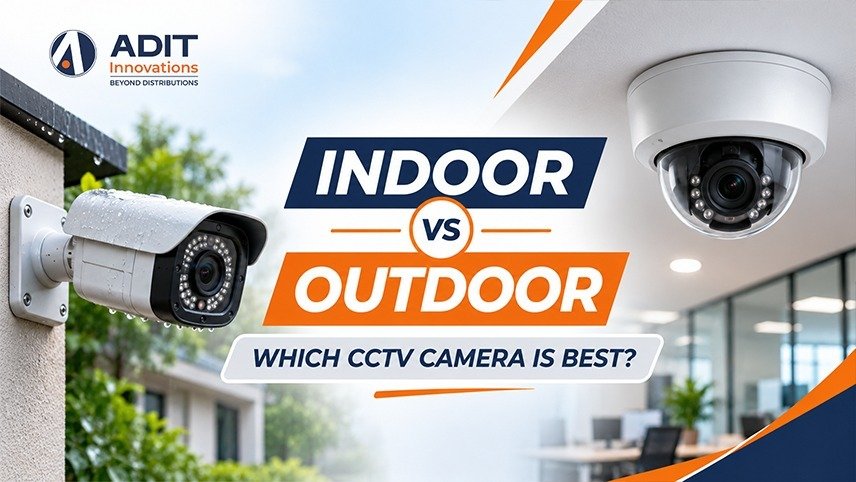
Why Location Decides the Camera Choice
A CCTV camera is designed to operate under specific environmental conditions. Outdoor cameras face rain, dust, heat, insects and changing sunlight, while indoor cameras generally operate in more controlled environments with shorter viewing distances and fewer weather related challenges.
These differences affect the camera housing, lens, night vision, power supply and installation method. Selecting a camera based on its intended location helps maintain image quality, reduce maintenance requirements and improve long term reliability.
A residential property may need weatherproof cameras for the entrance and driveway, along with compact indoor cameras for hallways. A commercial property may require outdoor cameras for parking areas and building perimeters, combined with indoor cameras for reception, corridors, offices and storage rooms.
The Adit Innovations team prepared this guide to explain the technical differences between indoor and outdoor cameras and help readers choose equipment according to their surveillance requirements.
Readers who want an overview of camera categories can first explore our CCTV camera guide on types, features and how to choose.
Outdoor vs Indoor CCTV Cameras at a Glance
| Feature | Outdoor CCTV camera | Indoor CCTV camera |
| Common types | Bullet, turret and PTZ | Dome, turret and fisheye |
| Weather protection | Typically IP66 or IP67 for exposed locations | Usually not required in controlled indoor environments |
| Impact protection | IK10 on selected models | Depends on the installation and risk |
| Operating temperature | Wider range suited to outdoor conditions | Range suited to indoor operating conditions |
| Night vision | Often 30 to 80 metres, depending on the model | Often 10 to 30 metres, depending on the model |
| Lens selection | 4 mm to 12 mm for many distance focused applications | 2.8 mm to 4 mm for many wider indoor views |
| Lighting requirements | Sunlight, headlights, shadows and darkness | Artificial lighting, windows and glass partitions |
| Typical resolution | 4 MP to 8 MP, depending on the application | 2 MP to 4 MP, depending on the application |
| Installation | Weatherproof mounting and protected cabling | Ceiling, wall or indoor surface mounting |
These are general planning guidelines, not fixed specifications. The correct camera depends on the distance to the subject, required image detail, lighting and environmental conditions.
Outdoor CCTV Cameras
Outdoor cameras monitor gates, driveways, boundary walls, parking areas, loading bays and building exteriors. Their design prioritises weather protection, suitable viewing distance and reliable operation under changing conditions.
Bullet cameras
Bullet cameras are a common choice for outdoor surveillance. Their elongated housing accommodates different lens configurations, while selected models offer powerful infrared illumination and weatherproof construction.
They suit gates, boundary walls, poles and building exteriors where a defined area needs continuous monitoring.
PTZ cameras
Pan tilt zoom cameras suit large parking areas, industrial yards and campuses. Optical zoom allows operators to examine distant subjects, while preset positions and tours help monitor multiple areas.
PTZ cameras are useful for active monitoring, although fixed cameras may still be needed to provide continuous views of important entry points.
Turret cameras
Turret cameras suit building corners, entrances and covered outdoor areas. Their lens design reduces the infrared reflection problems that can occur with some dome cameras, making them useful around glass partitions and reflective surfaces.
Specialised cameras
Thermal cameras can help detect temperature differences in specific applications, while an ANPR camera system is designed to capture vehicle number plates. These cameras serve specialised purposes and should be selected according to the actual monitoring requirement.
Useful outdoor camera features include:
- IP66 or IP67 protection against dust and water
- Suitable impact resistance for exposed or accessible mounting positions
- Wide Dynamic Range (WDR) for bright sunlight and deep shadows
- Infrared illumination suited to the required viewing distance
- A sunshield or hood to reduce glare and water accumulation
- Appropriate surge protection and earthing for exposed installations
A suitable outdoor camera combines these features with correct positioning and a stable power and network connection.
Indoor CCTV Cameras
Indoor cameras monitor reception areas, corridors, offices, retail floors, living spaces, staircases and server rooms. Their design generally prioritises discreet installation, wide viewing angles and sufficient image detail at shorter distances.
Dome cameras
Dome cameras are widely used indoors because their compact housings blend with ceilings and interior layouts. They suit reception areas, corridors, offices and retail environments.
Vandal resistant models are useful in public areas where cameras may be accessible to visitors.
Turret cameras
Turret cameras are suitable for corridors, entrances and rooms with reflective surfaces. Their lens arrangement can reduce infrared glare compared with cameras that have a glass dome covering the lens.
Fisheye cameras
Fisheye cameras capture a wide, sometimes 360 degree, view from a single mounting point. They can suit cafeterias, showrooms, open halls and other spaces where broad coverage is required.
The final image may require dewarping software to make the scene easier to review.
Compact WiFi cameras
A wireless security camera can be useful in rented homes, small offices or rooms where installing network cabling is difficult. A stable WiFi signal and a suitable power source are essential for reliable operation.
Wireless connectivity does not automatically mean the camera is completely cable free. Many models still require a power adapter, while battery powered models have separate charging and runtime considerations.
Useful indoor camera features include:
- Wide angle lenses for rooms and corridors
- WDR for entrances with bright windows
- Low light or colour night imaging for dim environments
- Privacy masking for screens and confidential work areas
- Two way audio where required and legally appropriate
For offices, camera placement should protect entrances and important operational areas without unnecessarily recording private or sensitive activities.
Our comparison of dome, bullet and PTZ cameras explains how each camera type suits different locations.
Weather and Impact Ratings Explained
Two important ratings help determine whether a camera is suitable for its installation environment.
IP rating
The Ingress Protection rating indicates the level of protection provided against solid particles and water.
IP66 indicates dust tight construction and protection against powerful water jets under specified test conditions. IP67 adds protection against temporary immersion under defined test conditions.
An IP67 rating does not automatically mean that a camera is suitable for permanent underwater use. Installation conditions and manufacturer instructions still matter.
For exposed outdoor locations, an appropriate IP66 or IP67 camera can help protect internal components from environmental exposure.
IK rating
The IK rating indicates resistance to mechanical impact. Selected cameras with IK10 protection are suitable for locations where physical contact or vandalism is a concern.
This can be relevant in public corridors, accessible entrances, parking facilities and other exposed locations.
Operating temperature
Outdoor cameras should support the temperature range expected at the installation site. Direct sunlight, summer heat, humidity and cold conditions can affect electronic components.
Review the manufacturer’s operating temperature specifications before selecting equipment.
Example. A camera installed at an exposed entrance in an area that experiences heavy rain needs suitable weather protection, sealed cable connections and a corrosion resistant mounting arrangement. An indoor camera without the required environmental rating may not provide reliable long term performance in the same location.
Lens, Night Vision and Lighting Differences
Lens selection, night imaging and lighting conditions influence how effectively a camera captures useful footage.
Lens choice
Indoor areas often benefit from wider lenses. A 2.8 mm lens can provide a broad view of rooms and corridors, depending on the camera sensor and lens specifications.
Outdoor areas may require narrower lenses to capture detail at a distance. A 6 mm lens generally provides a narrower field of view than a 2.8 mm lens, making it useful for selected gates, driveways and access routes.
Varifocal lenses allow the installer to adjust the field of view to suit the actual scene.
Night vision
Infrared LEDs illuminate the scene and produce black and white footage in darkness. Outdoor bullet cameras may offer infrared ranges of 30 to 80 metres, while many indoor cameras provide shorter ranges.
Actual performance depends on the camera model, lens, environmental conditions and the reflectivity of objects in the scene.
Low light sensors and suitable white light illumination can help capture colour details, including clothing and vehicle colours, where sufficient light is available.
Lighting control
Outdoor scenes experience sunlight, headlights, shadows and reflections. Indoor scenes may have bright windows beside dim corridors or reception areas.
Wide Dynamic Range helps balance bright and dark parts of an image. Correct camera placement also reduces glare from glass, walls and nearby light sources.
Resolution and identification
Resolution determines how many pixels are available to represent the scene, but useful identification also depends on distance, lens selection, lighting and camera angle.
For planning, approximately 250 pixels per metre is a useful reference for identification level detail, although requirements vary by application.
| Resolution | Horizontal pixels | Approximate scene width at 250 pixels per metre |
| 2 MP | 1920 | 7.7 metres |
| 4 MP | 2560 | 10.2 metres |
| 8 MP, 4K | 3840 | 15.4 metres |
A 4K IP camera may suit a wide entrance or an outdoor area where additional image detail is required. However, one high resolution camera does not always replace multiple cameras. Separate views may provide better coverage of entrances, blind spots and different viewing angles.
Power, Cabling and Connectivity
Both indoor and outdoor cameras can use an IP CCTV camera system, but the installation requirements vary by location.
Power over Ethernet
Power over Ethernet (PoE) allows compatible cameras to receive power and data through one Ethernet cable. Standard Ethernet channel runs are generally limited to 100 metres, subject to the equipment and network design.
Fixed cameras commonly operate with standard PoE, while some PTZ cameras and specialised models require higher power levels.
Outdoor cabling
Outdoor installations need suitable cables, weatherproof junction boxes and protected cable routes. Cable entries should be sealed according to the equipment manufacturer’s instructions.
Exposed installations may also require appropriate surge protection and earthing.
Indoor cabling
Indoor cables can run through ceilings, trunking or conduits to keep the installation organised and reduce accidental damage. Cable routes should remain accessible for future maintenance.
Wireless connectivity
Wireless cameras can simplify installations where network cabling is difficult. However, walls, interference, distance from the router and network congestion can affect connection quality.
Before installing a wireless security camera, test signal strength at the intended mounting location and confirm that the network can support the camera’s video stream.
Recording and storage
An IP camera system may use a Network Video Recorder (NVR) or compatible video management software for recording and playback.
Higher resolutions and higher bitrates generally increase storage and network requirements. Camera count, recording schedules and retention targets should therefore be considered during system planning.
Our guide to IP cameras versus analog cameras explains the main differences between these technologies.
Best CCTV Camera Types by Location
The following table provides a practical starting point for selecting cameras.
| Location | Suitable camera | Key considerations |
| Main gate | Outdoor bullet, typically 4 MP to 8 MP | Weather protection, WDR and lens selection |
| Driveway and boundary | Outdoor bullet or turret | Night vision and viewing distance |
| Large parking area | PTZ with fixed cameras at critical points | Optical zoom and continuous coverage |
| Building exterior | Outdoor turret or bullet | IP rating, impact resistance and glare control |
| Reception and lobby | Indoor turret or dome | WDR and clear facial detail |
| Corridors and offices | Indoor dome or turret | Wide field of view and discreet mounting |
| Open hall or cafeteria | Fisheye or multiple fixed cameras | Broad coverage and image usability |
| Server room or storage area | Indoor dome or turret | Access monitoring and appropriate image detail |
| Rented room or small office | Compact wireless camera | WiFi stability and power availability |
Example 1, a retail shop.
One outdoor 4 MP bullet camera covers the shopfront and entrance. Two indoor 4 MP dome cameras cover the sales floor, while another camera monitors the billing counter.
This combination provides outdoor protection and indoor coverage without using the same camera type in every location.
Example 2, a two storey home.
One outdoor 4 MP bullet camera covers the gate, and another monitors the rear entrance. Two indoor dome cameras cover the hallway and staircase.
A compact NVR can record the cameras, with storage sized according to the desired retention period.
Example 3, a warehouse.
Outdoor bullet cameras monitor the gate, loading bays and perimeter. Additional indoor cameras cover storage aisles and dispatch areas. A PTZ camera may provide an overview of the yard, while fixed cameras maintain views of critical locations.
A site survey confirms the mounting positions, viewing distances, lighting conditions and cabling requirements before the equipment is finalised.
Readers planning a deployment can review CCTV installation services from Adit Innovations to understand the process from site survey to handover.
Can One Camera Serve Both Settings?
Some cameras can be used indoors and outdoors, provided their specifications support the intended environment.
An outdoor rated camera can often operate indoors, although its housing may be larger than necessary for a small room. It can be useful in workshops, loading bays, garages and other indoor spaces exposed to dust or moisture.
Indoor cameras are designed for more controlled environments. They should not be installed in exposed outdoor locations unless the manufacturer explicitly specifies the required environmental protection.
Semi outdoor locations, such as covered verandas, open sided staircases and parking basements, need particular attention because they may experience humidity, dust and temperature changes.
Camera selection should consider more than the indoor or outdoor label. The housing rating, operating temperature, lens, lighting and mounting position must all match the conditions.
Cybersecurity is equally important in both settings. Change default passwords, update firmware, restrict remote access and use suitable network security controls to protect recorded footage.
Our article on securing surveillance networks covers these practices in more detail.
A Simple Selection Method
- List each camera location and classify it as indoor, outdoor or semi outdoor.
- Define the purpose of each camera, such as identification, general monitoring or vehicle observation.
- Select the required housing and weather protection for the installation environment.
- Match the lens and resolution to the viewing distance and required image detail.
- Review night vision, WDR and lighting conditions before finalising the model.
- Plan power, cabling, network connectivity and storage requirements.
- Check privacy requirements and secure remote access settings.
- Arrange a site survey to verify camera positions and coverage before installation.
Takeaway
Outdoor locations generally suit bullet, turret and PTZ cameras with suitable weather protection, appropriate lenses and reliable night vision. Indoor locations often suit dome, turret and fisheye cameras that provide clear detail and wide coverage in controlled environments.
The right choice depends on the mounting location, weather exposure, viewing distance, lighting and required image detail. Matching these factors to the camera specifications helps create a dependable CCTV camera system that performs well over time.
When you are ready to compare options for your premises, explore the CCTV camera range from Adit Innovations, or reach out through our Contact Us page to discuss your site’s requirements.
FAQs
1. Do outdoor CCTV cameras need an IP66 or IP67 rating?
These ratings are useful for many exposed outdoor locations because they indicate protection against dust and water. The appropriate rating depends on the installation conditions and manufacturer specifications.
2. Can an outdoor rated camera work indoors?
Yes. An outdoor rated camera can often operate indoors, including in workshops and loading areas where dust or moisture may be present.
3. Is a dome camera suitable for indoor ceilings?
Yes. Dome cameras are commonly used for indoor ceilings because their compact design suits reception areas, corridors and offices.
4. Do outdoor cameras usually have a longer night vision range?
Many outdoor bullet cameras offer longer infrared ranges than compact indoor models, but actual performance depends on the specific camera and scene.
5. Should an indoor camera be installed outdoors?
Only if the manufacturer specifies that it can withstand the environmental conditions. Standard indoor cameras generally lack the weather protection required for exposed outdoor installations.
6. Is a 4K IP camera always better than a 4 MP camera?
No. A 4K camera captures more pixels, but the best choice depends on the required detail, viewing distance, lighting, network bandwidth and storage capacity.
7. Is a wireless security camera suitable for a small office?
Yes, when the wireless signal is stable and the camera has a suitable power source. Wired cameras may be preferable where consistent connectivity and centralised infrastructure are priorities.